Special Feature: The role of rugby in sporting culture within the SW of France - Part I
By Markus Findlay, 04 December 2009
|
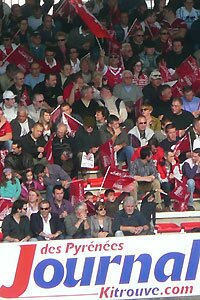
Tarbes fans soak up the
atmosphere at a home game
Photo: Colin Spiro
|
[In the summer of 2009 a young UK-based student called Markus Findlay came to France to investigate (as the above headline suggests) the cultural role of rugby within the French playing heartland of the south west. His trip was part-funded by a scholarship called the Charles de Gaulle Bursary which was awarded by The British Council. What follows is the end product he was required to submit, and I was so impressed that I decided to publish it on the website in two parts, starting with the first installment today - Ed]
Rugby?s personal attraction extends beyond the varied nature of the game, one where all aspects of skill are incorporated. The unique emphasis on inclusiveness and interdependence are the reasons why I am so passionate about rugby. I believe there is a universal appreciation for great spectacles of athleticism, similar to the times of antiquity where athletes were idolised for their physical qualities. This enthusiasm for rugby (and sport in general) is widespread in the southwest of France, and not dissimilar to the complete awe for the ancient athletes of the past.
The origins of this enthusiasm lie in the late C19th when English merchants and sailors first brought the game to northern France and set up the first club - Le Havre Athletic. Three further clubs were established in Paris in the following years. After 1899 the French championship, now opened to clubs outside Paris, was won by Stade Bordelais. This was a watershed in the nation?s sporting history that shifted the power base of French rugby to the south, which is now the heartland of the sport.
I have often felt some envy for such a community where the rugby culture is so valued. Something not expressed so tangibly in Britain - where games incorporating a more round ball are more appreciated! Whereas traditionally the ethos of rugby in Britain was to teach teamwork, and encourage character building, the sport in the south of France was, and is, largely an expression of identity.
'The spirit of investigative journalism'
The date is Friday 14th August 2009, and in the spirit of investigative journalism I take up an invitation to watch a training session of the professional side Sporting Club Albigeois. Now well accustomed to the French rail system, I take the train from headquarters Toulouse to Albi Ville station where I am greeted by Benoît, a local student and enthusiastic volunteer at the club who gives me a lift to the stadium. I befriended him at last week?s pre season friendly in the tiny rural town of Camarès, and am grateful for Benoît?s generosity.
Out of the burning sunlight from underneath the shelter of the shady grandstand I witness perhaps the best example of the French rugby spirit I could have hoped for. Whilst an intense training session unfolds, small children (also on the pitch!) provide encouragement and support, handing back stray balls and chatting casually now and again with players as if this is a routine event. It is also on this day that I discover a common feature of the sporting culture. This being only training, I am surprised to find a congregation of some 50 or 60 fans also watching. If not before, it was now clear to me that rugby plays a huge part here in the community. From head coaches to fans what I saw here was a family. There seemed to be no boundaries, no restrictions, a complete contrast to the detached world of professional sport in Britain.
Just days before, on a farm in the depths of the Pyrénées I was introduced to a French expression by Colin Spiro, a charismatic gonzo sports journalist from Essex, and the editor of the website frenchrugbyclub.com. The expression was "l?esprit de clocher". Bluntly defined as parochialism, this phrase underlines exactly what I saw in Albi. I was kindly lent a book by Colin called ?Inside French Rugby,? the poignant account of a retired New Zealand rugby player named John Daniell. The expression is often used by Daniell to explain the French sporting mentality and its various manifestations. In essence, l?esprit de clocher, literally translated as the spirit of the church bell tower, is the French ?credo of collective duty to the town, the team and the jersey?. However, symbolically it represents ?everything a good Frenchman holds close to his heart- his family, his friends, his town- the roots of an existence.?
The friendly family atmosphere I experienced in Albi was a perfect demonstration of this expression for me. However, the meaning of l?esprit de clocher extends beyond the apparent romantic community spirit. As pointed out by Daniell, historically the phrase meant that anyone who lived within earshot of the church bells was supposed to ?uphold the honour of that town in the traditional sport of la soule.? La soule is an extinct sport akin to rugby but not an ancestor. Often played between two rival towns, ?each side aimed to manhandle a ball made of leather or an animal?s bladder into their own goal, be it a wall, a tree or a body of water.?
Fiery pride
Although the sport is long gone the fiery pride it inspired lives on in France, now through the medium of rugby. George Orwell?s quote ?serious sport is war minus the shooting? portrays the combative nature of the sport in general, but the magical part of rugby is its inclusive nature and the prevalent ethos of sportsmanship.
|
Sell-out crowds are the norm
in France's Top 14 these days
Photo: Tom Oddy
|
Serge Simon, a former French prop, once said of rugby: ?C?est un jeu où on peut se etre des marrons et puis aller boire des bières ensemble après? - ?It?s a game where we can slap each other around and then go and have a beer together afterwards?. The French rugby culture has always valued these principles, in fact Daniell indicates that ?once the game had been won, the recipient of the soule - probably an inn keeper or the local noble - was obliged to put on food and drinks for the victors as recognition of their valour on behalf of the village.?
The post match communal meal has great social importance in France. On my visit to Millau to watch another pre season friendly, I was privileged enough to sit in on a meal with the Sale Sharks after their game against Montpellier. There, in a modified barn I was amongst players and fans alike, sat together enjoying a meal. But another notable feature of this occasion was the willingness of the French players to sign autographs and pose for photographs with their young fans - whilst in the middle of their dinner.
I was confused. Were the French fans just more audacious, or were the players just very kind? These were my thoughts, as I sat absorbing the occasion, placed opposite at the table from French international and Montpellier back row Fulgence Ouedraogo, as a small girl approached whilst he was eating. Rudi Keil, the South African Sale Sharks player enlightened me, saying: ?In France the players are very conscious that they are only where they are because of their fans.? I wondered whether the same could be said of the footballers in the English premiership?
The next destination my project led me to was the town of Brive-la-Gaillard, located in the department of Corrèze in the Limousin region. During the 10 days I spent there I discovered something about the changing role of rugby in France. As Daniell describes it, the town of Brive is ?picturesque, the countryside beautiful, and the food excellent, but there is not a lot going on - apart from rugby.?
I navigate my way to the auberge de jeunesse on what is another scorching day. After checking in I arrive at the hallowed ground of Club Athlétique Briviste, to give them their full name. Tonight is the first game of the new season, and I am very fortunate to be spending the next week at the club on work experience.
The British invasion
|
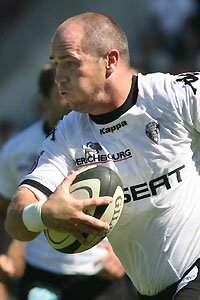
Shaun Perry: One of the
burgeoning 'Brit-pack' in France
© Diarmid Courreges
|
The British Liaison Officer at the club is a man named Keith Charge, a former policeman from Bath; this friendly warm-hearted man is perhaps the most passionate man I have ever met. He is responsible for organising this opportunity, and I meet him outside the ticket office with his wife Julia before the match begins. It fascinates me that Keith, who once held a season ticket at Bath for 10 years, is so enthusiastic for this French team. He declares that he would buy the club tomorrow if he won the lottery!
As I am introduced to the staff I discover that there are quite a few British people involved in the set up. In fact, I am told there are over 150 British season ticket holders here alone, not including the regular attendees. I immediately realise why the club?s website is also in English, something I would later be responsible for translating. The nickname of ?Brive England? given to the team (with five capped England players in the squad) by the British sporting press also seems an appropriate title for the club itself. But why is this, and why is there even a need for a British Liaison Officer at what is a French club?
In answer to my previous question Keith tells me that Chief Executive Simon Gillham, another British person, has his ?finger very much on the pulse.? He saw the opportunity to entice the large population of British expatriates living in the nearby Dordogne to be involved with the club, hence the need for a British Liaison Officer, an ambassador for the Anglophone community within the club, and a writer for the witty English column in the match day programme.
Pitch invasions
Despite the tireless unpaid work Keith does for the club, (between thirty and thirty five hours a week!) I couldn?t help thinking there must have been something else that transformed these people from Brits to Brivistes. Keith?s enthusiasm certainly was contagious, but later on that evening I witnessed the animated carnival atmosphere of the match against Montpellier, and the routine post-match pitch invasion - a chance for the fans to meet their heroes. These experiences were like nothing I had seen before, and certainly enough to make me a fully-fledged supporter myself. ?Long may the pitch invasion last? says former policeman Keith, as we stroll across the turf ourselves on the way to the function room. I really admired the sense of accessibility here. It seemed, as Keith said, the club was very much ?in touch with the grassroots.?
But I was not content! I wanted to know what it was about Brive, and French rugby in general that won Keith over so overwhelmingly. The root of his enthusiasm lies in the story of the European Cup Final of 1998. The match between Bath and Brive was held in Bordeaux. Committed Bath fans in those days, Keith and Julia travelled to France for what was a nail-biting encounter. The game and therefore the title went Bath?s way by a single point. But the significance of this story was not the game itself.
As the match ended and they stood up from their seats, satisfied and ready to leave the ground, they were beckoned over by a gathering of surprisingly jovial Brive fans. On their approach glasses of fine champagne were poured out for them and they enjoyed a long bonding conversation. Touched by the hospitality they were shown, Keith told me in his deep voice that the event ?underlined perfectly the spirit of rugby?. Thereafter, Keith and Julia planned holidays in France that would coincide with Brive matches, before they would eventually emigrate completely to the country, partly for the lifestyle - but mainly for the rugby.
To be continued in Part 2...
|